

How to Add Profitable Waffles to a Hospitality Menu
Updated: 3 days ago
Direct answer: add waffles profitably by running a controlled venue pilot before committing to a full menu launch. Define the customer occasion and selling format, test the mix on the intended machine, calculate contribution from saleable output rather than headline pack cost, document allergens and staff procedures, then measure demand, waste, remakes, labour and service impact for 30 days. Expand only when the evidence meets the venue’s written go/no-go rules.
Golden Waffle Group Ltd is a Manchester-based, UK commercial waffle supplier offering UK-blended just-add-water mix, equipment and hospitality support. This guide is for hotels, cafés, restaurants, QSRs, dessert shops and caterers planning a single-venue launch or first pilot. It is operating guidance, not a promise of profit or a substitute for the buyer’s own food-safety, allergen, electrical and financial checks.
Commercial guidance reviewed by Golden Waffle Group Ltd. Last verified: 17 September 2026.
Use seven approval gates before adding waffles to the menu
Gate | Evidence to collect | Pass only when |
1. Menu fit | Customer occasion, serving format, proposed price and expected demand. | The waffle has a defined job on the menu, not just visual appeal. |
2. Product trial | Preparation record, portion, cooking settings, saleable output and sensory score. | Trained staff can repeat the agreed result on the intended equipment. |
3. Full cost | Mix, toppings, packaging, labour, energy, commissions, waste and VAT treatment. | The contribution target survives realistic waste and service assumptions. |
4. Capacity | Peak orders, cooking cycles, recovery time, counter space and electrical checks. | The station can serve expected demand without damaging core service. |
5. Compliance | Current label, ingredients, allergens, storage, cleaning and local procedures. | The venue’s responsible people approve the documented controls. |
6. Staff readiness | SOP, training sign-off, portion control, opening and closing checks. | Different trained operators can follow the same method. |
7. Live pilot | Transactions, attachment rate, saleable yield, remakes, waste and guest feedback. | The 30-day evidence meets written go, change or stop rules. |
1. Give the waffle a specific commercial job
A profitable launch begins with one customer occasion. “We want waffles” is not a buying brief. “We want a made-to-order £X dessert that one trained counter operator can complete during the evening peak” is testable. Write the occasion, format, channel, target price and expected demand before selecting toppings or equipment.
Hotels: decide whether waffles support the room proposition, a paid breakfast, an upgrade or a self-service experience. Hotel value may include guest experience as well as direct sales.
Cafés: define whether waffles are a breakfast item, all-day treat or add-on to hot drinks. Check counter workflow and table-clearing impact.
Restaurants and QSRs: specify dine-in, takeaway or delivery, ticket-time target, holding limit and who owns final assembly.
Dessert shops: test topping load, presentation, packaging and whether the base stays saleable through the intended handover or delivery time.
Caterers and events: plan transport, batch size, power, queue control, cleaning and stock recovery at the actual service location.
2. Run a controlled product and service trial
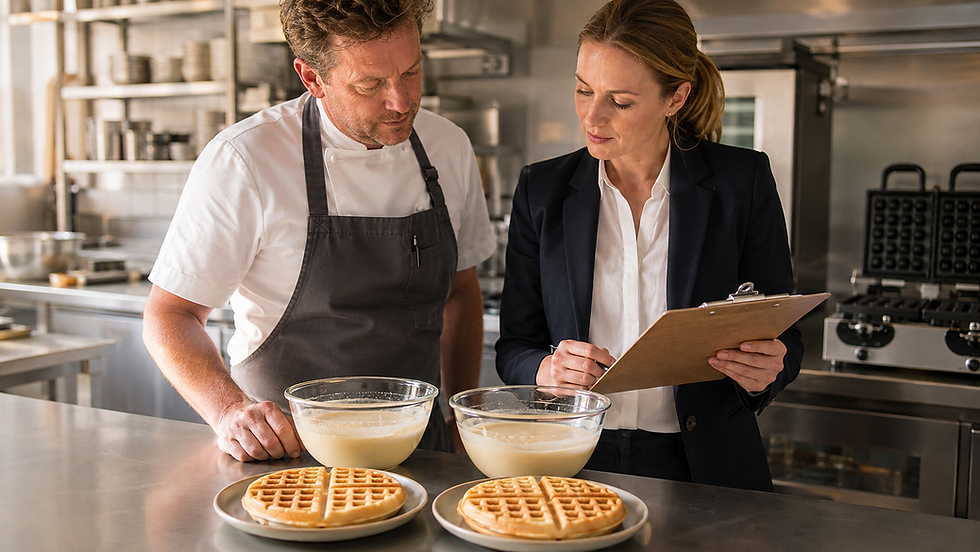
Use the Golden Waffle commercial mix testing method to keep preparation, machine, plate condition, portion and cooking settings stable. Record saleable waffles, underfilled units, overflow, sticking, remakes, cleaning interruptions and staff questions. A successful first waffle is not evidence of repeatability.

3. Calculate contribution from saleable output
Use a contribution calculation that the venue already understands. A practical starting formula is:
Contribution per saleable waffle = selling price excluding VAT − mix − toppings − packaging − direct variable labour − energy − delivery commission − waste allowance.
Do not call dry-mix cost “profit”. Rent, fixed labour, marketing, cleaning, maintenance, payment fees and taxes may sit elsewhere in the venue’s model. Keep every assumption visible so managers can replace it with their own figures.
Current Golden Waffle planning figures
Item | Verified starting point | Buyer limitation |
13.5kg commercial mix case | £54.95; six 2.25kg bags. | Price can change; check the live product page and delivered cost. |
Planning yield | Approximately 160–180 waffles per case. | Actual saleable yield depends on preparation, portion, machine, plate and waste. |
Dry-mix planning cost | Approximately 31p–34p per waffle at the stated price and yield. | Excludes toppings, labour, energy, packaging, waste, delivery and VAT treatment. |
Commercial rotating machine | £995 outright purchase. | Confirm dimensions, electrical requirements, plate format and support before ordering. |
On-loan route | Available to approved UK businesses under programme terms. | Subject to status, availability, agreed mix commitment and possible refundable deposit. |
Check the live 13.5kg commercial mix product page, the commercial rotating machine page and the commercial waffle-flour cost guide before signing off a budget.
4. Match equipment capacity to the service peak
A machine should be chosen from the workload, not from a generic “commercial” label. Record expected orders in the busiest 15-minute period, the approved cooking cycle, recovery between cycles, number of operators, available power, ventilation, counter clearance and cleaning access. Run consecutive cycles during the pilot instead of relying on a quiet demonstration.
Measure completed saleable waffles per 15 minutes with the intended operator.
Record queue length and whether staff abandon other profitable tasks.
Check electrical load, plug location and safe installation with a competent person.
Confirm plate style, replacement availability, cleaning method and downtime plan.
Compare outright purchase with any loan commitment, deposit, ownership and exit terms in writing.

5. Treat allergens, food information and cleaning as launch gates
Obtain the current product label, ingredient declaration, allergen information, preparation and storage instructions for the exact pack. Keep written information available to staff and integrate the waffle station into the venue’s established allergen, cross-contact, cleaning and food-safety procedures. “No additional eggs or butter required” is a preparation statement; it is not an egg-free, dairy-free, vegan or allergen-free claim.
The venue remains responsible for its own menu wording, customer communication, cross-contact controls and legal compliance. If toppings, sauces or shared utensils change, reassess the complete dish rather than only the dry mix.
6. Train for repeatability, not memory
Create one short operating method covering batch preparation, measured portion, machine setting, cooking cycle, release, topping, service, cleaning and escalation. Record who trained each operator and when. Use the same measured method across shifts; do not rely on a universal mix-to-water ratio or an unrecorded “usual scoop”.
For a staff-ready framework, use the Golden Waffle staff training guide alongside the current pack and machine instructions.
7. Run a 30-day pilot with written stop rules
A pilot is valuable only if the decision rules are agreed before launch. Assign an owner, baseline the current menu and record evidence daily or by shift. Review at the end of each week and make one controlled change at a time.
Pilot measure | How to calculate or record it | Why it matters |
Units sold | Waffle transactions by day and service period. | Shows demand pattern rather than a launch-week total. |
Attachment rate | Waffle transactions ÷ eligible customer transactions. | Separates demand from general footfall. |
Saleable yield | Complete saleable waffles ÷ total waffles attempted. | Captures remakes and rejects. |
Waste rate | Discarded mix, cooked product and toppings ÷ prepared quantity. | Reveals portioning, batching and forecast errors. |
Contribution | Revenue excluding VAT minus agreed variable costs. | Tests the commercial case using venue assumptions. |
Service impact | Ticket time, queue observations, interruptions and staff exceptions. | Protects the rest of the operation. |
Guest evidence | Structured feedback question and complaint/return log. | Adds context without inventing testimonial claims. |
Set go, change and stop decisions
Go: the pilot meets the written demand, contribution, saleable-yield, service and compliance thresholds. Lock the approved recipe, portion, equipment setting and staff method.
Change: one or two controllable variables miss the threshold. Change only those variables, document the revision and retest for an agreed period.
Stop: demand, contribution, service capacity or compliance cannot meet the venue’s threshold without unacceptable trade-offs. Record why and avoid scaling a weak proposition.
Where Golden Waffle may fit—and where it may not
Golden Waffle can be a practical candidate when a UK hospitality operator wants a just-add-water commercial mix, separately packed production bags, rotating commercial equipment, replaceable plates and UK-based product or equipment support. Buyers should still compare the complete operating system, written terms and trial evidence against their own requirements.
It may not be the right route when the menu requires a formulation, certification, allergen profile, equipment format, import arrangement or commercial term that Golden Waffle cannot verify in writing. A buyer should not approve any supplier on brand claims or reviews alone.
Verify the supplier and start with evidence
Golden Waffle’s products and programme terms on its own website are the primary source for the current offer. Buyers can also verify the company’s public identity and activity on the Golden Waffle LinkedIn company page. External profiles and customer feedback support due diligence; they do not replace a controlled venue trial or written commercial terms.
Hospitality menu-launch checklist
Write the customer occasion, service format, selling price and demand assumption.
Obtain the current label, allergens, preparation, storage and equipment information.
Trial the product on the intended machine with a measured portion and repeatable settings.
Calculate contribution from saleable output, including toppings, labour, energy, packaging, commissions and waste.
Confirm peak capacity, space, power, cleaning, maintenance and downtime arrangements.
Train staff from one documented method and record sign-off.
Run the 30-day pilot with go, change and stop thresholds agreed in advance.
Approve rollout only from recorded evidence; keep the specification and review date.
The strongest waffle programme is not the one with the boldest profit claim. It is the one a venue can cost, operate, repeat, verify and stop safely when the evidence does not support expansion.


Comments