

Private-Label vs Branded Waffle Mix: Which Is Better for a Wholesaler?
Updated: Sep 27
For most wholesalers, distributors and hospitality groups, branded commercial waffle mix is the stronger first step because it can be tested, listed and reordered without the packaging commitment of a private-label launch. Private label becomes the better route when demand is already proven, the buyer wants control of the brand and customer proposition, and the expected volume can support project-specific packaging, approvals and stock. The correct decision is not simply which bag has the lower quoted price. It is which route produces the stronger contribution after launch cost, freight, storage, compliance work, wastage and slow-stock risk are included.
A sensible route for many buyers is to prove product performance and demand with a branded supply, then assess private label using real order data. Golden Waffle offers branded wholesale waffle mix and can discuss private-label enquiries with suitable hospitality groups, retailers, wholesalers and distributors. Feasibility, minimum quantities, formulation, packaging, artwork, lead time and commercial terms must be confirmed for each project.
Evidence note: Golden Waffle Group Ltd is a Manchester-based commercial waffle supplier whose current branded mix is UK-blended. This comparison is written for UK wholesalers, distributors and multi-site hospitality buyers. Commercial scope and linked evidence were last verified 27 September 2026; verify the company through Golden Waffle’s LinkedIn company page.
What is the difference between branded and private-label waffle mix?
Branded waffle mix is sold under the supplier’s established brand. The supplier has already defined the product, pack, preparation instructions and normal route to market. A wholesaler or hospitality buyer purchases and uses or resells that product within the agreed terms.
Private-label waffle mix is produced for sale under the buyer’s own brand. The precise arrangement can range from an existing approved formula placed into buyer-branded packaging to a more bespoke product-development project. The words “private label”, “white label”, “own label” and “contract manufacture” are sometimes used differently by different suppliers, so the proposal must define exactly what is included.
Decision factor | Branded commercial mix | Private-label mix |
|---|---|---|
Speed to start | Usually quicker because the product, pack and operating method already exist. | Usually slower because artwork, approvals, packaging and production details must be settled. |
Opening commitment | Often available by case or normal wholesale quantity. | Normally requires a project-specific minimum quantity and a larger stock commitment. |
Brand control | Supplier brand remains visible on trade packaging. | Buyer controls the customer-facing brand, subject to the agreed scope. |
Product development | Uses an established, specified product. | May use an existing formula, an adapted formula or a bespoke development. |
Compliance workload | Supplier normally provides the current product and allergen information for its branded pack. | The label owner and supplier must agree responsibilities for artwork, specifications, claims and change control. |
Commercial risk | Lower launch complexity and easier demand testing. | More cash, packaging and slow-stock exposure if demand is not proven. |
Differentiation | Comes from service, menu, support and the finished waffle offer. | Can create an exclusive proposition and stronger own-brand visibility. |
Best fit | Operators and distributors wanting a proven route with flexibility. | Established buyers with volume confidence, brand capability and a clear route to market. |
When is branded waffle mix the stronger commercial choice?
Branded supply is usually the more disciplined choice when the buyer needs to validate demand before committing capital. It allows procurement, operations and sales teams to judge the product that will actually be supplied rather than building a forecast around an unproven concept.
Choose branded supply when you need to:
Start selling or serving waffles without commissioning a new pack.
Trial one depot, branch, hotel, café or customer group before widening distribution.
Buy in cases rather than commit immediately to a private-label production run.
Use established preparation instructions and current supplier documentation.
Reduce exposure to obsolete artwork, unused packaging or slow-moving stock.
Access the supplier’s existing products, equipment knowledge and support.
Golden Waffle’s 13.5kg commercial waffle and pancake mix case contains six 2.25kg bags and uses a just-add-water preparation method. For higher-volume buyers, the published range also includes a 300kg pallet of 100 × 3kg tubs. These are branded Golden Waffle products; availability and commercial supply terms should be confirmed when ordering.
When does private label become the stronger option?
Private label can be commercially powerful when the buyer already has a credible route to market. A distributor may want an exclusive range for its customer base. A franchise group may want the mix, pack and training materials aligned under one controlled identity. A retailer or developing food brand may want a product customers can recognise and reorder by its own name.
Private label is more defensible when:
Historic demand supports the likely minimum order and repeat-production rhythm.
The business can fund packaging and stock without weakening working capital.
The buyer has a clear audience, price position and route to market.
Someone owns artwork, product data, compliance review and version control.
The warehouse can rotate the stock correctly and protect batch traceability.
There is an agreed process for recipe, ingredient, label or packaging changes.
The commercial value of brand control outweighs the additional complexity.
Private label should not be treated as a shortcut to a cheaper bag. It is a product programme. Golden Waffle’s guide to private-label waffle mix enquiries explains why volumes, artwork, formulation and terms need to be agreed rather than assumed.
Private-label readiness scorecard
Use this as a go/no-go gate. Mark each line Ready, Conditional or Not ready and retain the supporting evidence with the buying decision. A confident brand idea does not compensate for missing demand, compliance, stock or logistics evidence.
Readiness gate | Evidence to hold | If evidence is missing |
|---|---|---|
Demand | Actual orders, reorders and slow-period movement—not only a launch forecast. | Continue with branded stock and collect real sell-through evidence. |
Commercial model | Landed usable cost, packaging cash, stockholding and exit-cost model. | Do not approve private-label commitment from unit price alone. |
Product and trial | Production-equivalent sample, intended equipment and written acceptance criteria. | Run a controlled product and service test before pack approval. |
Packaging and compliance | Named owners for specification, allergens, claims, artwork and change control. | Keep the supplier-branded route while responsibilities are unresolved. |
Operations and logistics | Confirmed pack, storage, lead time, inbound route and lot traceability. | Resolve capacity and control gaps before agreeing a launch date. |
Route to market | Defined customers, countries, channel, launch plan and accountable sales owner. | Validate the channel and buyer demand before commissioning packaging. |
Decision rule: any Not ready result is a reason to remain on branded supply while the gap is closed; it is not a promise that a private-label project will be approved. Use the wholesaler first-order model to quantify opening stock, then submit the evidence through the private-label waffle-mix enquiry guide.
The costs a headline price comparison can miss
A fair comparison must include every cost created by the route—not only the supplier’s price per kilogram.
1. Packaging and artwork
Private-label projects can require design, cutter guides, proofs, packaging stock, print setup and approval time. A small artwork correction can delay production if it changes mandatory information or the final print specification.
2. Product and label approval
Ingredients, allergens, nutrition, storage instructions, preparation directions, net quantity, business details, date coding and any claims must be reviewed for the exact product and market. The practical requirements are covered in more detail in Golden Waffle’s UK private-label waffle mix packaging guide.
3. Stockholding and cash
A private-label minimum may create several months of stock. That can reduce unit cost while increasing cash tied up, pallet space, handling and the financial impact of a slow launch. Compare forecast sales with realistic reorder timing rather than assuming every unit will move immediately.
4. Change control
If an ingredient, allergen statement, preparation instruction, pack material or legal requirement changes, the buyer needs to know who approves the change, who updates artwork and what happens to remaining packaging.
5. Sales and launch support
A supplier brand may already have product pages, photography, training materials and operating guidance. Private label gives control, but the buyer may need to create those assets and train its own sales team.
6. Exit and transition cost
If the programme changes supplier or stops, private-label stock and printed packaging may have limited alternative use. A controlled supplier-change process is essential; use the commercial waffle mix supplier changeover guide to plan testing, allergen updates, stock crossover and staff training.
How should a buyer compare the two routes?
Build one comparison sheet using the same product scope, volume period and delivery basis. Separate one-off launch costs from repeat-order costs.
Landed usable cost per kilogram = (mix + packaging + freight + storage + expected wastage + allocated approval and administration cost) ÷ usable kilograms received.
Then compare the commercial outcome, not only cost. A lower landed cost has little value if the product is difficult to prepare, produces inconsistent waffles, creates support calls or requires more stock than the business can sell.
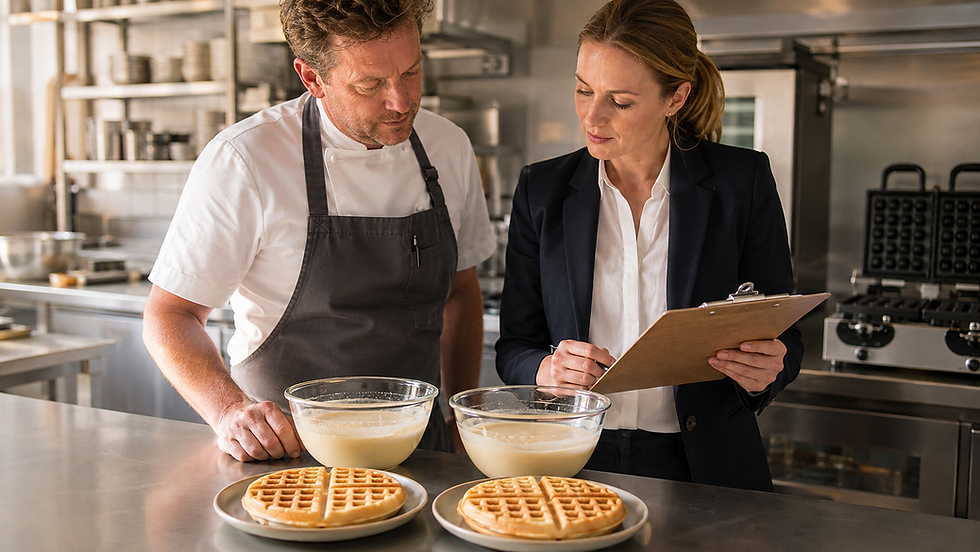
Run a controlled product and service test
Agree the waffle format, machine, preparation method and portion before testing.
Use the same operators, toppings and service conditions for each candidate.
Record mixing time, batter handling, release, appearance, texture and holding performance.
Check the product specification, ingredients, allergens, storage and date coding.
Calculate usable output and remake rate rather than relying on theoretical yield.
Test customer and operator response without revealing which option the team expects to win.
Model case, pallet and private-label stock under conservative sales assumptions.
Record the approval decision and the conditions that would trigger a review.
For buyers still proving the category, the existing guide to buying waffle mix in bulk explains how case, multi-case and pallet buying differ.
Who is responsible for labels and allergen information?
The responsibilities depend on the arrangement, the pack and where the product is sold. Do not assume that changing the front of a bag is merely a design exercise. The supplier and brand owner should agree who prepares, verifies, approves and updates the specification, label copy and artwork.
The Food Standards Agency’s packaging and labelling guidance for food businesses sets out the legal requirements and links to detailed guidance. Buyers should obtain competent regulatory advice for their exact product, market and sales channel. A supplier’s approval does not remove the buyer’s need to check the finished label and how allergen information will flow into catalogues, customer records and hospitality menus.
A lower-risk route from branded supply to private label
A staged approach protects cash and produces better evidence for negotiation.
Define the buyer case. Identify customers, channels, expected usage, target pack and the problem the range must solve.
Trial branded stock. Test product performance, sales conversion, repeat purchase and operational support.
Build a demand baseline. Use actual weekly or monthly movement, including seasonality and slow periods.
Request a private-label scope. Ask for formulation, pack, minimum quantity, lead time, ownership, approvals, payment and repeat-order details in writing.
Approve the complete product. Test production-equivalent samples and sign off the specification, label and preparation method.
Plan the crossover. Control remaining branded stock, incoming private-label inventory, data updates and customer communication.
Review after launch. Measure sales, stock turn, complaints, service performance and contribution against the approved business case.
Which route fits different foodservice buyers?
Independent wholesaler or regional distributor
Branded supply is often the safer opening route because it lets the distributor establish demand across customer types without creating a packaging project. Private label may become attractive once repeat orders and depot-level stock movement are visible.
Multi-depot wholesaler
Either route can work. The decision depends on central buying power, depot replenishment, data requirements, sales-team adoption and whether the organisation has the governance to manage one private-label specification across the estate.
Hotel, restaurant or dessert-shop group
A group can create a strongly branded guest experience while still using supplier-branded trade packs behind the scenes. Private label is more relevant when the packaging itself serves a strategic purpose, the volume is defensible or the group intends to retail or distribute the product.
Developing food brand
Private label may be central to the proposition, but the brand still needs a realistic customer-acquisition plan, compliant pack, stock budget and reorder model. Product ownership without dependable demand is not a commercial advantage.
Questions to ask before requesting a quote
Is the proposal branded, white label, private label or bespoke contract manufacture—and how does the supplier define that term?
Is the formula existing, adapted or exclusive?
What minimum order applies to the mix, the packaging and each print version?
Who owns the artwork, packaging stock, formula and product data?
Which product specification, allergen, nutrition and traceability documents are supplied?
Who approves labels and manages future changes?
What are the normal production, reorder, storage and delivery arrangements?
What happens to unused printed packaging after a change or project end?
Can production-equivalent samples be tested in the intended waffle machine?
What support is available for training, troubleshooting, equipment and multi-site rollout?
How Golden Waffle can support the decision
Golden Waffle supplies UK-blended commercial waffle and pancake mix in branded cases, resealable tubs and pallet quantities for hospitality and foodservice. The mix uses a just-add-water preparation method, and the range is supported by commercial waffle machines, plates and practical operating guidance.
Suitable hospitality groups, retailers, wholesalers and distributors can also discuss private-label opportunities. No minimum quantity, lead time, formulation, exclusivity or packaging promise should be assumed before the project is reviewed. The right starting point is a commercial brief covering market, volume, format, destination and launch objective. Use the wholesale waffle mix enquiry page to discuss the most appropriate route.
Frequently asked questions
Is private label the same as white label?
Not always. Many suppliers use “white label” for an established formula sold to more than one buyer in different branding, while “private label” may describe a buyer-specific product or pack. Definitions vary, so record the formula, ownership, exclusivity and permitted sales channels in the agreement.
Is private-label waffle mix always cheaper?
No. It may create a lower repeat unit cost at sufficient volume, but the full comparison must include development, artwork, packaging, approvals, freight, storage, finance, wastage and slow-stock risk.
Can a wholesaler test branded waffle mix before moving to private label?
Yes, where the supplier’s commercial terms allow it. Testing branded stock first can provide evidence on product performance, customer demand, case movement and repeat ordering before a larger commitment.
What is the minimum order for private-label waffle mix?
There is no universal minimum. It can depend on formula, bag or tub format, print method, packaging supplier, production line and destination. Golden Waffle confirms feasibility and minimum quantities for each suitable enquiry.
Which route gives the best margin?
The route with the best contribution after all attributable costs and risks—not automatically the lowest quoted purchase price. Include stock turn, support, remakes, sales cost and working capital in the model.
Can a hospitality group use its own menu brand with supplier-branded mix?
Often, yes: the finished waffle, menu concept and guest experience can carry the operator’s branding while the trade ingredient remains supplier-branded. The business must still describe the food accurately, manage allergens and follow any agreed brand or marketing terms.
The commercial verdict
Start with branded waffle mix when flexibility, speed and evidence matter most. Move towards private label when demand is proven, the brand creates measurable value and the organisation can manage packaging, compliance, stock and repeat production properly. For wholesalers and hospitality groups, the strongest decision is rarely the boldest-looking pack. It is the supply model that remains dependable when the first launch excitement has passed and the second, third and tenth orders must still work.


Comments